Last Updated: February 02, 2026
For millions in 2025, waking up to a "digital blackout" became a reality. From total bans in Afghanistan to election shutdowns in Guinea, internet freedom faced unprecedented attacks.
While we often think of the internet as a given, 2025 proved just how fragile that connection really is. From military juntas in West Africa to constitutional crises in the Pacific, governments shut down the network with alarming frequency.
When governments shut down the network, citizens fought back. Our internal data reveals a massive global migration to privacy tools, with VPN usage spiking by over 3,500% in a single day in some regions.
These aren't just statistics. They are the digital footprints of millions of people refusing to be silenced.
Key Stat: VPN usage surged 174% as citizens scrambled to bypass a total social media blockade.
Date: October 7, 2025
The Trigger: Total ban on Facebook, Instagram, and X (Twitter)
The single most critical VPN spike of late 2025 didn't come from a war zone, but from a policy decision that silenced an entire nation overnight.
On October 7, the Taliban administration announced a sweeping ban on virtually all major social media platforms. Citing the need to prevent "immoral acts," authorities ordered ISPs to block Facebook, Instagram, and X immediately following a two-day total internet blackout.
The reaction was instantaneous.
In a country where social media is the primary source of independent news and family connection, the digital blockade created a panic. Our data shows VPN usage surged by 180% within days, a historic migration that underscores a simple truth: you can block the apps, but you cannot block the need to connect.
Why VPNs were essential: In a country where independent news is scarce, VPNs allowed citizens to tunnel through ISP-level blocks and access vital information channels like WhatsApp and X.

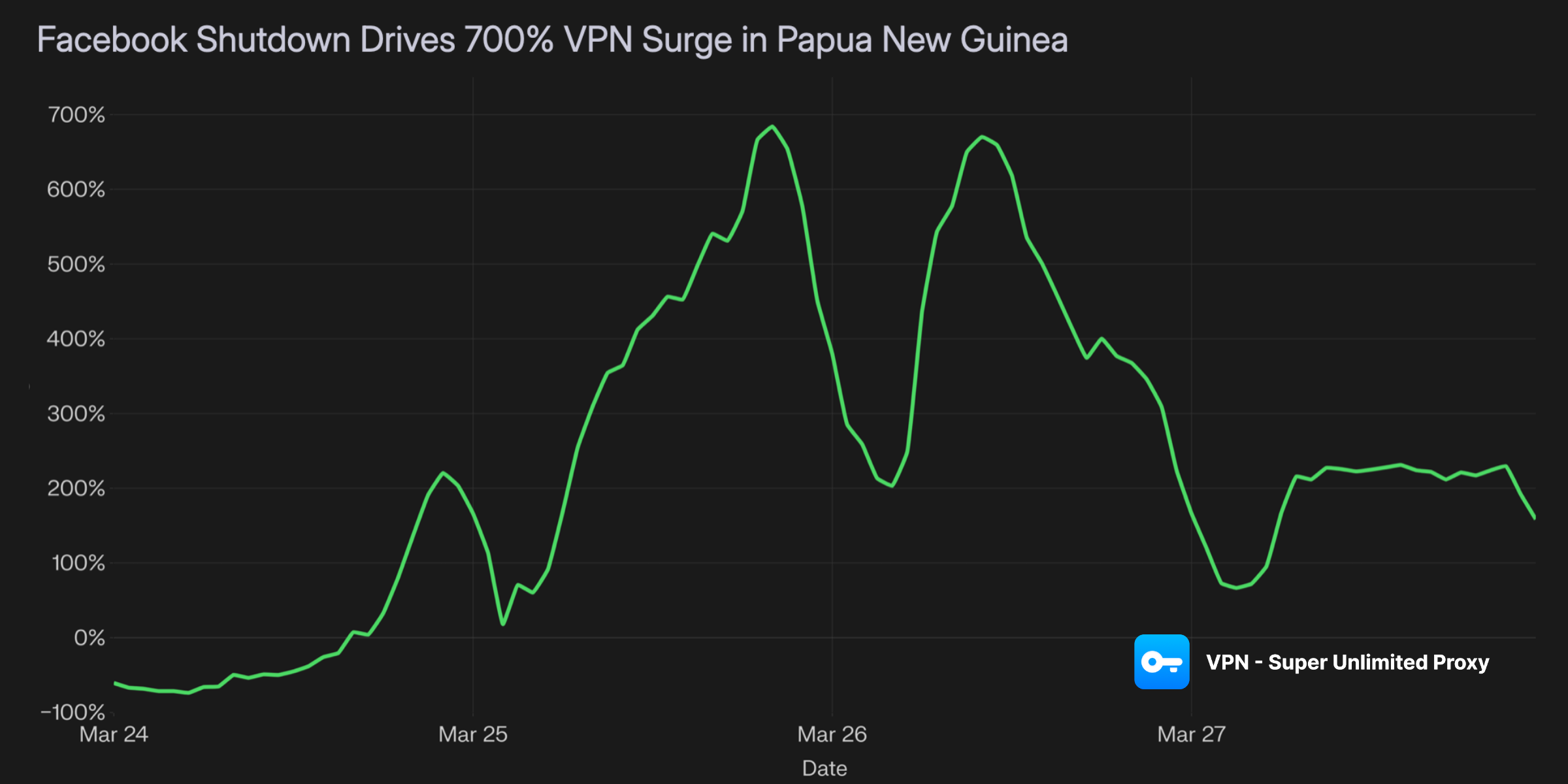
Key Stat: A "test" shutdown of Facebook triggered a massive 684% rise in VPN adoption in 48 hours.
Date: March 25, 2025
The Trigger: A nationwide Facebook shutdown "test"
Usually, censorship tries to hide in the shadows. In Papua New Guinea, it was announced as a public experiment.
In late March, the government initiated a shutdown of Facebook, framing it as a "test" to curb misinformation, hate speech, and pornography. The timing, however, raised eyebrows, it coincided perfectly with a high-profile court appearance by Prime Minister James Marape.
For the citizens of PNG, where "internet" and "Facebook" are often synonymous, this wasn't just an inconvenience; it was a communications blackout.
The result? A massive 684% surge in VPN adoption as users scrambled to bypass the block. The backlash was so severe that the "test" was abandoned within 48 hours, proving that in 2025, taking away Facebook is a political third rail.
Why VPNs were essential: For many in PNG, Facebook is the internet. VPNs provided the only route to bypass the geo-block and restore communication with families and businesses.
Key Stat: Protests against term limit changes drove a 669% increase in VPN usage to document unrest.
Date: June 26, 2025
The Trigger: Anti-government protests against term limit changes
When a government changes the rules to stay in power, the first casualty is often the truth.
In June, massive protests erupted in Lomé after President Faure Gnassingbé’s government pushed through constitutional changes that would effectively reset his term limits, allowing him to rule indefinitely.
As thousands of Gen Z protesters took to the streets, the digital crackdown began. Internet speeds were throttled, and social media access became spotty. Sensing a total blackout was imminent, Togolese citizens turned to VPNs en masse, driving a 669% usage spike.
This digital lifeline allowed protesters to document the violent crackdown by security forces and share evidence with the world, proof that connectivity is now a key tool in modern resistance.
Why VPNs were essential: Activists used VPNs to upload videos of the crackdown to the cloud, preserving evidence that would otherwise be lost to local censorship.
.png)
Key Stat: Preemptive downloads drove a staggering 3,556% spike days before the election.
Date: December 23, 2025
The Trigger: Presidential election preparations
Elections are supposed to be a celebration of democracy. In Guinea, they were a cause for digital preparation.
Days before the December 28 presidential election, the first since the 2021 coup, anxiety reached a fever pitch. With a history of election-day blackouts in the region, citizens didn't wait for the plug to be pulled.
Preemptive VPN downloads skyrocketed by a staggering 3,556% on December 23. This wasn't a reaction to a block; it was insurance against one. It shows a growing trend where citizens anticipate censorship and "suit up" with privacy tools days before the ballot boxes even open.
Why VPNs were essential: Citizens anticipated a shutdown based on historical precedents. The massive spike wasn't reactive, it was insurance. By downloading VPNs before the election, voters ensured they had a lifeline if the grid went down.
.png)
Key Stat: A bureaucratic ban on 26 apps led to a 558% revolt in digital traffic.
Date: September 4, 2025
The Trigger: Ban on 26 social media platforms
Imagine if your government banned not just TikTok, but everything.
In September, Nepal’s government issued a sweeping ban on 26 different social media platforms, including Facebook, Instagram, X, YouTube, and WhatsApp, citing their failure to establish local offices and comply with new regulations.
The ban effectively dismantled the country's digital infrastructure overnight. Small businesses that ran on Instagram collapsed. Families communicating via WhatsApp were cut off.
The response was a digital revolt. VPN usage surged 558% as users refused to let a bureaucratic dispute silence their daily lives. The protests that followed weren't just about free speech; they were about the right to exist in the modern economy.
Why VPNs were essential: Small businesses that run on Instagram and families relying on WhatsApp were cut off instantly. VPNs became a critical business tool, allowing commerce and communication to continue despite the ban.
.png)
Key Stat: A second major spike of 315% occurred during the constitutional referendum.
Date: September 23, 2025
The Trigger: Constitutional referendum aftermath
Guinea appears on this list twice, proving that 2025 was a volatile year for its digital rights.
Months before the general election, the military junta held a constitutional referendum to pave the way for a transition of power. As results were being tallied, access to major video and messaging platforms like TikTok, YouTube, and Facebook was severely restricted.
The 315% spike in VPN traffic during this period highlights the "cat and mouse" game of modern censorship: governments throttle specific apps to control the narrative, and citizens immediately tunnel through those blocks to find the unfiltered truth.
Why VPNs were essential: Throttling targets specific protocols. High-quality VPNs with obfuscation features allowed users to mask their traffic, bypassing the bandwidth limits placed on social media apps.
.png)
Key Stat: Conflict in Goma drove a 800% rise in VPN usage for secure communication.
Date: February 2, 2025
The Trigger: Rebel capture of a major city
When war comes to your doorstep, information becomes a matter of life and death.
In February, Rwanda-backed M23 rebels launched a major offensive, capturing Goma, the largest city in eastern DRC. As panic spread and telecommunications infrastructure came under threat, the flow of reliable information dried up.
Residents turned to VPNs (+800% spike) not to watch Netflix, but to access encrypted messaging apps like WhatsApp and Signal. In a conflict zone, a secure connection is the only way to coordinate evacuations, check on loved ones, and share news without fear of surveillance or interception.
Why VPNs were essential: In conflict zones, unencrypted calls can be intercepted. VPNs provided encryption for WhatsApp and Signal calls, allowing civilians to coordinate evacuations securely.
.png)
Key Stat: A 318% surge occurred as citizens reconnected after a total blackout.
Date: June 26, 2025
The Trigger: Partial restoration after conflict-driven blackout
Iran is no stranger to internet shutdowns, but June 2025 was different.
Amid escalating regional conflict and the "Twelve-Day War," the regime imposed a near-total internet blackout starting June 18. For over a week, the country was digitally dark.
When the switch was finally flipped back on around June 26, millions of Iranians rushed online only to find their favorite platforms still blocked by the "National Information Network" firewall. The result was a 318% surge in VPN usage as the population desperately tried to reconnect with the outside world and confirm their safety to relatives abroad.
Why VPNs were essential: The domestic intranet (intranet) blocks most global sites. VPNs were the bridge back to the global internet, allowing Iranians to confirm their safety to relatives abroad.
.png)
Key Stat: A proposed 90-day social media ban triggered a 250% immediate spike.
Date: January 23, 2025
The Trigger: Nationwide social media ban
"You are grounded from the internet for three months."
That was essentially the message sent to the people of South Sudan in January. Amid growing civil unrest, the government ordered all ISPs to block access to social media platforms for a period of up to 90 days.
The ban was intended to stop the spread of protests. Instead, it fueled a massive digital migration. VPN usage spiked 250% immediately after the announcement. The backlash was so swift, both domestically and internationally, that the ban was lifted just six days later, a rare victory for digital resistance.
Why VPNs were essential: The ban threatened to isolate the country entirely. The massive uptake in VPNs showed that citizens were unwilling to accept a quarter-year of digital silence.
.png)
Key Stat: A looming TikTok ban drove a 481% increase in VPN downloads.
Date: March 12–13, 2025
The Trigger: Nationwide TikTok block
In 2025, censorship didn’t always look like a “shutdown.” Sometimes it looked like a single app, one that millions rely on for news, culture, and community, being quietly pulled from the wall.
That’s what happened in Albania, where authorities ordered internet providers to block TikTok by March 13. Our data recorded a 481% spike in VPN usage on March 12, right as the block approached, an early sign that users were scrambling to keep access before the door closed.
It’s a familiar pattern: when one platform is blocked, people don’t stop communicating, they simply reroute. And once citizens learn that a major app can disappear overnight, many start using VPNs not just to access TikTok, but to future-proof their online freedom.
Why VPNs were essential: TikTok is a primary source of news and culture for Gen Z. Users installed VPNs proactively to ensure they wouldn't lose access to their community when the ban took effect.
.png)
If 2025 taught us anything, it's that blocking the internet doesn't work.
Every time a government tried to block access, whether for an election, a protest, or a "test", it didn't stop the flow of information. It just redirected it through a secure tunnel.
The message from global citizens is loud and clear: We will not be silenced.
As we move into 2026, the battle for the open internet is only intensifying. Governments are getting smarter with their blocks, targeting VPN protocols and using deep packet inspection. But the people are getting smarter too.
Are you prepared for the next shutdown?
Don't wait until the lights go out. Download a VPN today and ensure you always have a lifeline to the free and open internet. Because in the digital age, access isn't just a luxury, it's a right.
Governments often cite "national security," "preventing misinformation," or "public safety" as reasons. However, data shows spikes often correlate with elections, protests, or political crises.
In most countries, using a VPN is legal. However, some regimes restrict their use. It is crucial to download a reliable VPN before a shutdown occurs, as app stores may be blocked later.
A VPN encrypts your internet traffic and routes it through a server in a different country. This masks your IP address, making it look like you are browsing from a free location, bypassing local ISP blocks.


.png)